Mechanism-Guided Precision Hydrolysis of Early Transition Metals to Access (Mixed-Metal) Oxo Clusters
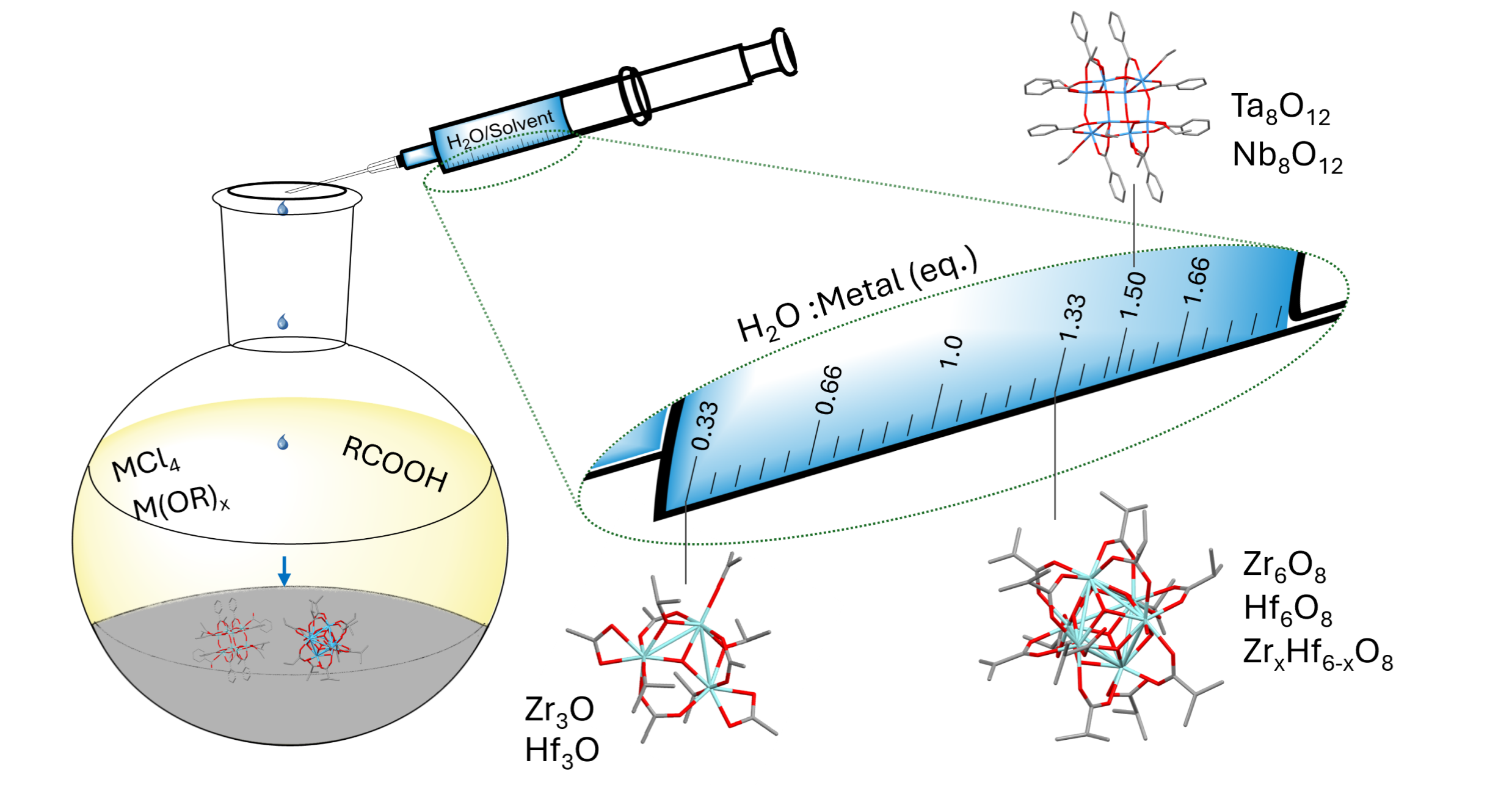
Zirconium and hafnium oxo clusters are catalysts, and building blocks for MOFs, 3D-printing and polymer composites. However,their synthesis is often a matter of trial and error, and new structures are hard to design retrosynthetically. Here, we use our recent insight in the formation mechanism of Zr6O4(OH)4(OOCR)12 oxo clusters to redesign their synthesis with higher reaction rates, more economical precursors, more sustainable solvents, and higher atom economy, all at room temperature at gram scale. We add exactly 1.33 equivalents of water for the precision hydrolysis of the metals toward Zr6-carboxylate or Hf6-carboxylate oxoclusters (carboxylate = acetate, oleate, and 2-methylbutanoate). Furthermore, we use precision hydrolysis to synthesize the elusive bimetallic Zr/Hf oxo clusters and to expand rational oxo cluster synthesis to the group 5, accessing the new Nb8O12(OEt)8(OBz)8and Ta8O12(OEt)8(OBz)8 clusters (OBz = benzoate). Precision hydrolysis allows for a rational design and an economic production of oxo clusters on a multigram scale, with potential to become the workhorse for cluster synthesis.