Bimetallic Silylation Reagents: Structural Investigation and Reactivity of Caesium Silylzincates
Organosilicon compounds are fundamental building blocks in organic synthesis, playing a crucial role in the development of pharmaceuticals and agrochemicals. Silylboranes have emerged as versatile precursors for the incorporation of silicon atoms into molecular frameworks, often in combination with alkali-metal bases to generate highly reactive metal silyl reagents.1,2 On the other hand, zinc silyl reagents typically require the use of transition-metal catalysis in order to promote these transformations.3
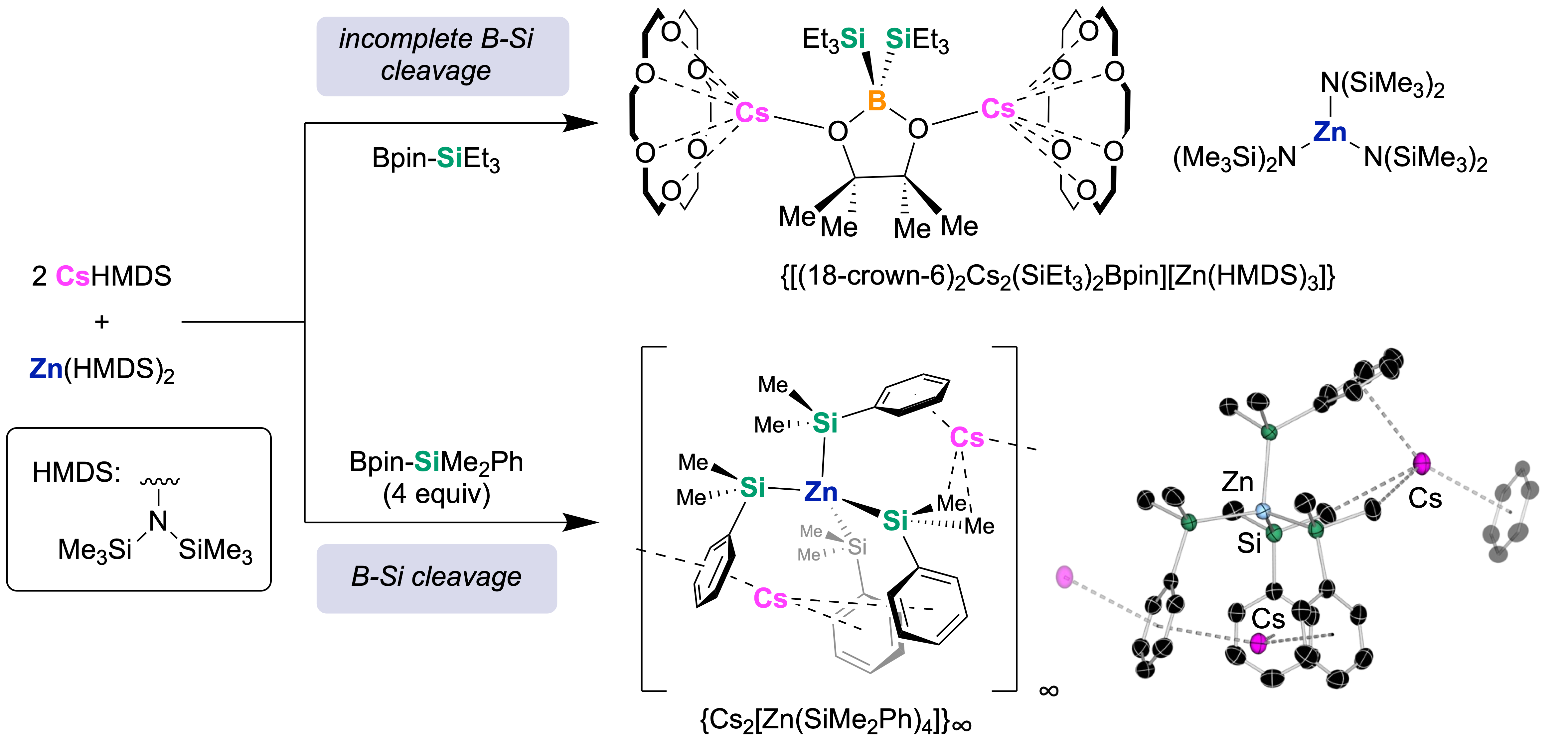
Opening new ground in this area, here we present the synthesis and reactivity of novel caesium zincate complexes bearing silyl ligands. By switching on bimetallic cooperation, these compounds exhibit unique nucleophilic profiles, allowing for the silylation of C-halogen bonds of bromo- and iodoarenes. These heterobimetallic silyl complexes are prepared by heteroleptic cleavage of the relevant silyl borane with a 2:1 mixture of Cs(HMDS) and Zn(HMDS)2 (HMDS= N(SiMe3)2). Remarkably, the presence of aryl groups on the silyl substituent is key in order to favour the cleavage of the B-Si bond. This can be rationalized in terms of the formation of additional Cs-π-aryl electrostatic interactions which contribute to the overall stability of the newly generated caesium zincate, as shown in the Scheme for [Cs2Zn(SiMe2Ph)4].
[1] Zhihua Cai, Qing-Qing Bu, Xi-Yu Wang, Shengchao Yang, Jian Zhou, Jin-Sheng Yu, Chem. Sci. 2025, 16, 2154–2169.
[2] Eiji Yamamoto, Satoshi Ukigai, Hajime Ito, Synlett 2017, 28, 2460–2464.
[3] Michinori Suginome, Hiroshi Nakamura, Yoshihiko Ito, Chem. Commun. 1996, 2777–2778.