Enhanced sensitivity and reduced spectral overlap in ENDOR spectroscopy with chirped pulses
Electron–Nuclear Double Resonance (ENDOR) spectroscopy is a powerful magnetic resonance technique for probing the geometric and electronic structure of paramagnetic centers, including transition metal complexes and metalloproteins, through combined microwave (MW) and radiofrequency (RF) pulse sequences. Unlike conventional paramagnetic NMR, ENDOR selectively detects nuclei in the immediate vicinity of the unpaired electron spin, providing direct insight into catalytically and biologically active sites. This is particularly important for understanding structure–function relationships in transition metal catalysts, such as Ti(III)-based Ziegler–Natta systems, and metalloproteins such as ScoI-Cu(II).
However, ENDOR studies of such systems are often limited by low sensitivity and severe spectral overlap arising from broad, anisotropic transitions and multiple interacting nuclei, especially for low-γ and quadrupolar nuclei commonly encountered in catalysis and biology.
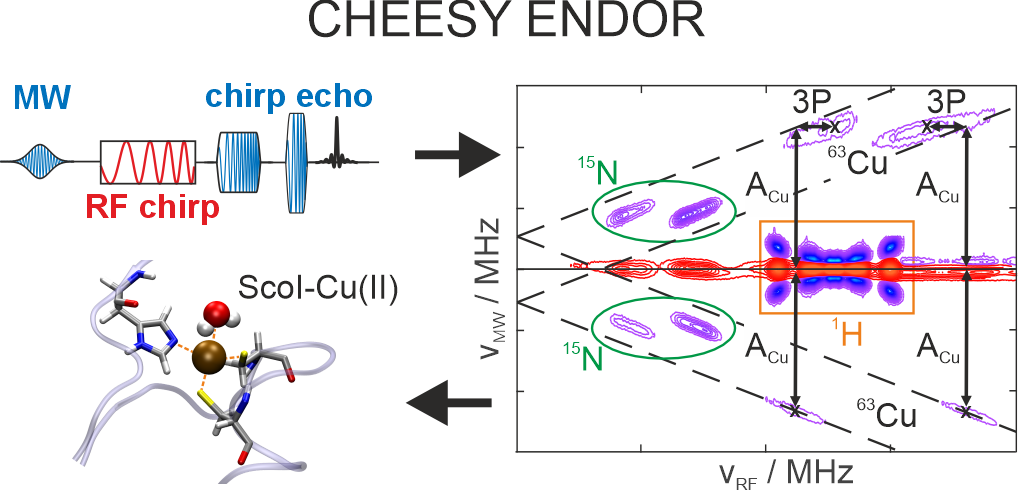
In this talk, I will show how advances in instrumentation and pulse ENDOR methodology overcome these challenges by improving both sensitivity and spectral resolution. Inspired by NMR spectroscopy, we implemented chirped (frequency-swept) microwave pulses for broadband detection of electron spin transitions in CHEESY ENDOR, introducing a second spectral dimension that separates overlapping features and simplifies spectral analysis. [1] In addition, chirped RF pulses enhance sensitivity in frequency-domain ENDOR by exciting a larger fraction of nuclear spin transitions, particularly for broad resonances of low-γ nuclei such as Cu(II) and Ti(III). [2] Using ScoI–Cu(II), a metalloprotein essential for the biogenesis of mitochondrial complex IV in the respiratory chain, we demonstrate how these methods resolve overlapping signals from different nuclei (1H, 14/15N, 63Cu) and separate hyperfine from quadrupolar interactions, enabling a more accurate determination of spin Hamiltonian parameters and electronic structure. These developments significantly extend the applicability of ENDOR spectroscopy to challenging problems in transition metal catalysis and bioinorganic chemistry, enabling studies of previously inaccessible nuclei such as 27Al, 47/49Ti, and 63Cu. [3]
[1] Stropp, J. et al., Phys. Chem. Chem. Phys., 2025, 27, 25624-25635
[2] Stropp, J. et al., Magn. Reson., 2025, 6, 33–42.
[3] Inoue, M., Stropp, J. et al. J. Am. Chem. Soc. 2025, 147, 19, 16438–1644