Ligand-Dependent Lipid Bilayer Disruption by Atomically Precise Metal Clusters
Atomically precise metal nanoclusters have emerged as highly promising nanomaterials for biomedical applications owing to their ultrasmall dimensions (<2 nm), atomically defined structures, tuneable ligand shells, and remarkable opto-electronic properties. Their structural precision and surface versatility enable the design of nanoclusters with tailored functionalities for therapeutic and diagnostic applications.
Despite these advantages, a comprehensive understanding of their interactions with biological membranes remains limited. Since the cell membrane represents the first biological barrier encountered by nanomaterials, elucidating nanocluster–membrane interactions are crucial for both the rational development of biocompatible nanomaterials and the assessment of potential nanotoxicological effects[1].
In this study, three different atomically precise metal nanoclusters, Au25(GSH)18, Au25(Capt)18, and Au25(MHA)18, were employed to investigate their interactions with POPC lipid bilayers as model cell membranes. The interactions between the nanoclusters and lipid bilayers were systematically analysed using ATR-FTIR spectroscopy, QCM, and AFM measurements.
The results revealed that although all nanoclusters possess the same Au25 core, variations in the ligand shell led to significantly different interaction with the membrane. In particular, the Au25(MHA)18 nanoclusters induced complete disruption of the lipid bilayer, whereas the other ligand-protected clusters exhibited comparatively weaker effects on membrane integrity. These findings demonstrate that ligand shell chemistry plays a critical role in governing nanocluster–membrane interactions and membrane destabilization mechanisms.
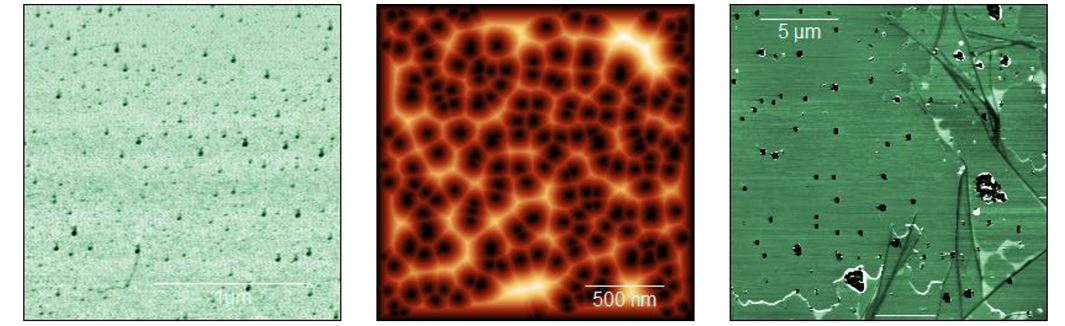
Figure 1. Left. Phase AFM image of Au25(Capt)18 on lipid bilayer. Middle. Voronoi diagram shows effective area per nanocluster for Au25(Capt)18 on lipid bilayer. Right. Phase AFM image shows disruption of the lipid bilayer by Au25(MHA)18.
[1] Sarita Bhattacharya, Thomas Bürgi, et al., ACS applied materials & interfaces 2022, 14(26), 29521-29536.