Time-resolved photoelectron imaging of photochemistry at aqueous droplet surfaces
Photochemical reactions at the air–water interface can be accelerated by up to several orders of magnitude [1,2], a phenomenon with major impact on our understanding of atmospheric chemistry. However, the investigation of the mechanisms behind the rate increase remains challenging due to difficulties in correlating the observed changes in reaction rate to the underlying electronic structure.
Photoelectron spectroscopy, combined with a pump–probe scheme, enables temporal resolution of photoinduced dynamics through direct probing of the evolving electronic structure. We present preliminary data from surface-sensitive time-resolved femtosecond UV pump–probe photoelectron imaging (PEI) of aqueous submicron aerosol droplets. Phenol and phenolate were chosen as high-interest well-characterized model systems, given their role as aromatic chromophores in atmospheric aerosols. The experimental results show signatures consistent with hydrated electron formation from electron ejection into the solvent, revealing sub-ns timescale decays of 266 nm-photoexcited phenol and phenolate at the droplet surface.
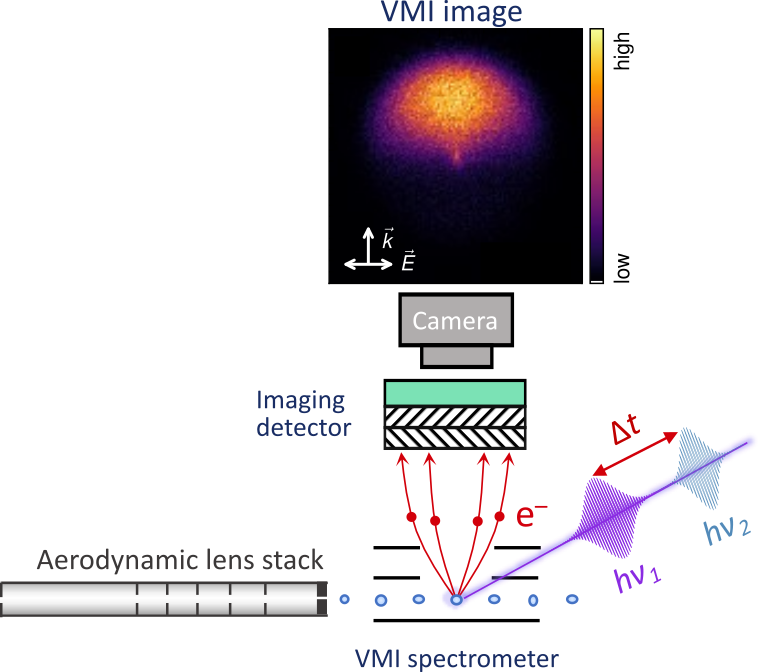
Our technique (Fig. 1) benefits from the high surface-to-volume ratio of aerosols, and surface sensitivity, due to the limited escape depth of the probed low-kinetic-energy electrons. This enables us to resolve the electronic structure and photodynamics of molecules at the droplet surface [3,4], closely resembling real atmospheric conditions. Our work complements photoelectron spectroscopy with liquid jets [5,6], and sum-frequency generation techniques at air–water interfaces [2].
[1 ] R. Kusaka et al. Nat. Chem., 2021, 13, 306–311
[2] C. J. C. Jordan et al. J. Am. Chem. Soc., 2022, 144, 14012–14015
[3] J. Heitland et al. J. Phys. Chem. A, 2024, 128, 7396–7406
[4] J. Heitland et al. Phys. Chem. Chem. Phys., 2026, 28, 5935–5947
[5] D. H. Kang et al., Phys. Chem. Chem. Phys., 2026, 28, 7754–7765
[6] K. Robertson et al., Chem. Sci., 2023, 14, 3257–3264