Two molecular pathways for ion-driven "structure making / braking" in water revealed by Correlated Vibrational Spectroscopy
Aqueous anions are commonly classified as “structure makers” or “structure breakers” based on how they affect water, which is deduced from macroscopic observables, yet the underlying molecular mechanisms remain debated because most spectroscopies do not directly isolate water–water hydrogen bonds. Here we use Correlated Vibrational Spectroscopy (CVS)1, a hyper-Raman based approach that separates self-correlated (single-molecule / isotropic) from cross-correlated (collective / interacting) vibrational responses, thus isolating the cross-correlated water–water H-bond stretch near 205 cm-1. Which allowed us to quantify the changes in strength of orientationally cross-correlated H-bonds, and the number of such interacting H-bonds. We apply CVS to 2 M sodium salt solutions2. The data reveal two distinct pathways by which anions modify the water HB network. Soft, polarizable anions induce large red shifts (up to −62 cm-1 for I-) together with strong increase in cross-correlated intensity (up to +56% interacting H-bonds), consistent with charge-transfer mediated weakening of individual H-bonds accompanied by an increased concentration of correlated water–water interactions. In contrast, hard anions show only small frequency shifts and modest intensity changes, consistent with predominantly electrostatic perturbations. These contrasting molecular responses are rationalized using Hard–Soft Acid–Base (HSAB) theory3, showing that similar macroscopic trends can arise from fundamentally different microscopic mechanisms due to compensation between H-bond strength and the number of H-bonds.
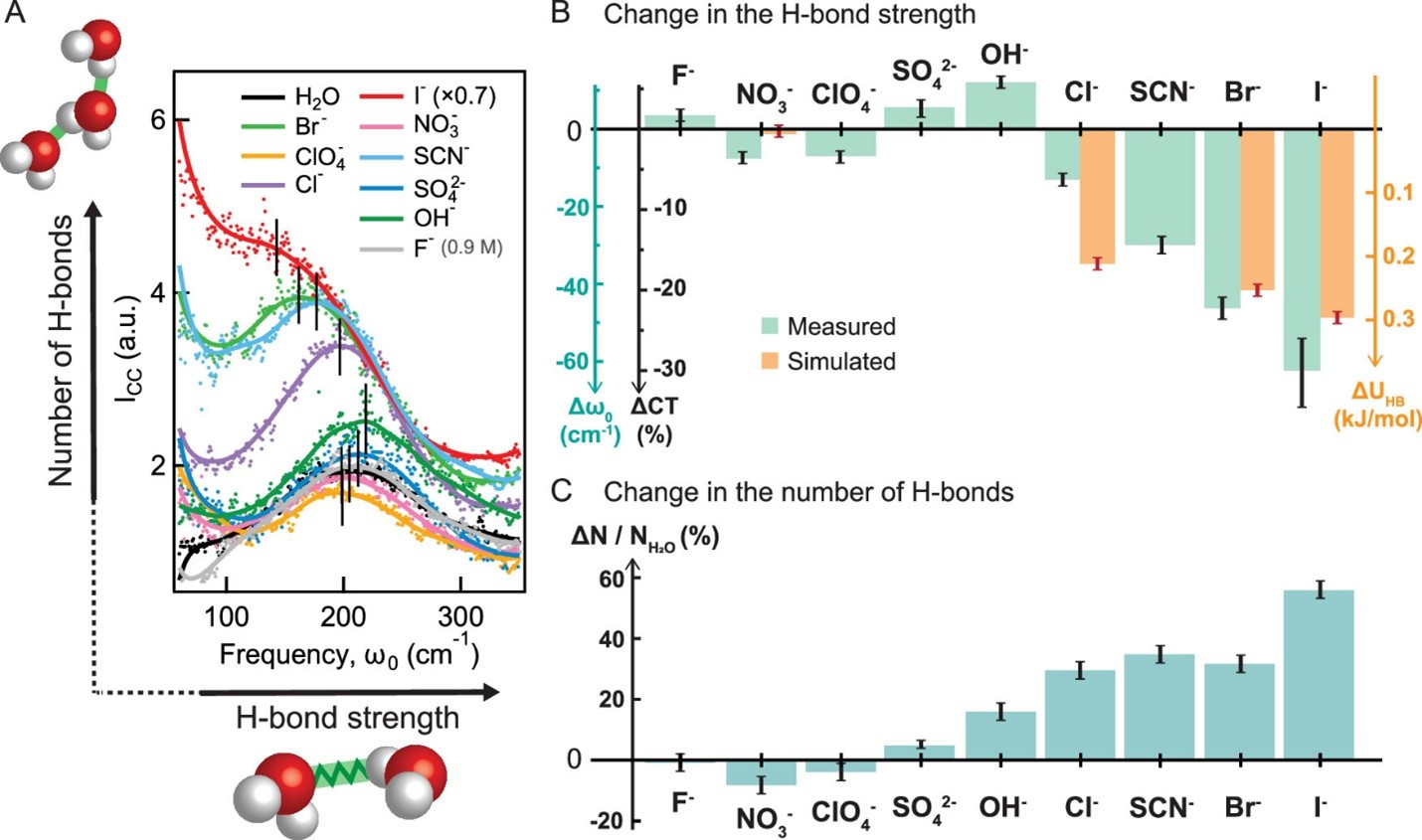
Figure 1: Ion-specific modification of the water–water H-bond network measured by CVS in concentrated sodium salt solutions. The cross-correlated H-bond stretch frequency shift reports changes in H-bond strength (and associated charge-transfer), while the intensity reports the relative change in the number of orientationally cross-correlated (interacting) H-bonds, revealing distinct behaviors for soft vs hard anions.
[1] M. Flór et al., Science 2024, 386, eads4369.
[2] M. Flór, V. Vorobev et al., J. Am. Chem. Soc. 2025, 147, 37328–37336.
[3] R. G. Pearson, J. Am. Chem. Soc. 1963, 85 (22), 3533−3539.