A Molecular Movie of Photoinduced Structural Dynamics in Diazocine Captured by Small-Molecule Time-Resolved Serial Femtosecond Crystallography
Photochemistry is governed by coupled electronic and nuclear dynamics on femtosecond-to-picosecond timescales, where many product-determining steps occur. Conventional structural methods typically capture only static snapshots or long-lived intermediates. Time-resolved serial femtosecond crystallography (TR-SFX) overcomes this limitation by resolving structural change with femtosecond time resolution, complete reciprocal-space sampling, and sub-Ångström spatial precision, enabling real-space molecular movies. While TR-SFX has transformed the study of ultrafast biomolecular reactions, including light-induced isomerisation, bond formation and cleavage, and electron transfer,[1] it has until recently been largely restricted to large-unit-cell crystals such as photoactive proteins and, more recently, metal–organic frameworks.[2] Here, enabled by new analysis methods and indexing algorithms, we demonstrate TR-SFX on small-molecule, capturing an azobenzene derivatives[3] ultrafast structural dynamics and opening a route to molecular movies of small-molecule photochemistry.
I first give a brief overview of TR-SFX before presenting our analysis of diazocine photodynamics. We reconstruct a time series from extrapolated structures and difference electron density, with frames every 10 fs and an effective time resolution of ~150 fs. While a single 300 fs frame is shown below, the full time series follows the earliest structural response: N=N bond twisting within 150 fs, redistribution of distortion into the ethyl bridge, and progressive planarisation of the molecule. After ~1 ps, crystal disorder develops and diffraction intensity decreases, marking the loss of long-range structural order. These results demonstrate that small-molecule TR-SFX can resolve reaction pathways and help guide the design of solid-state photoactive materials.
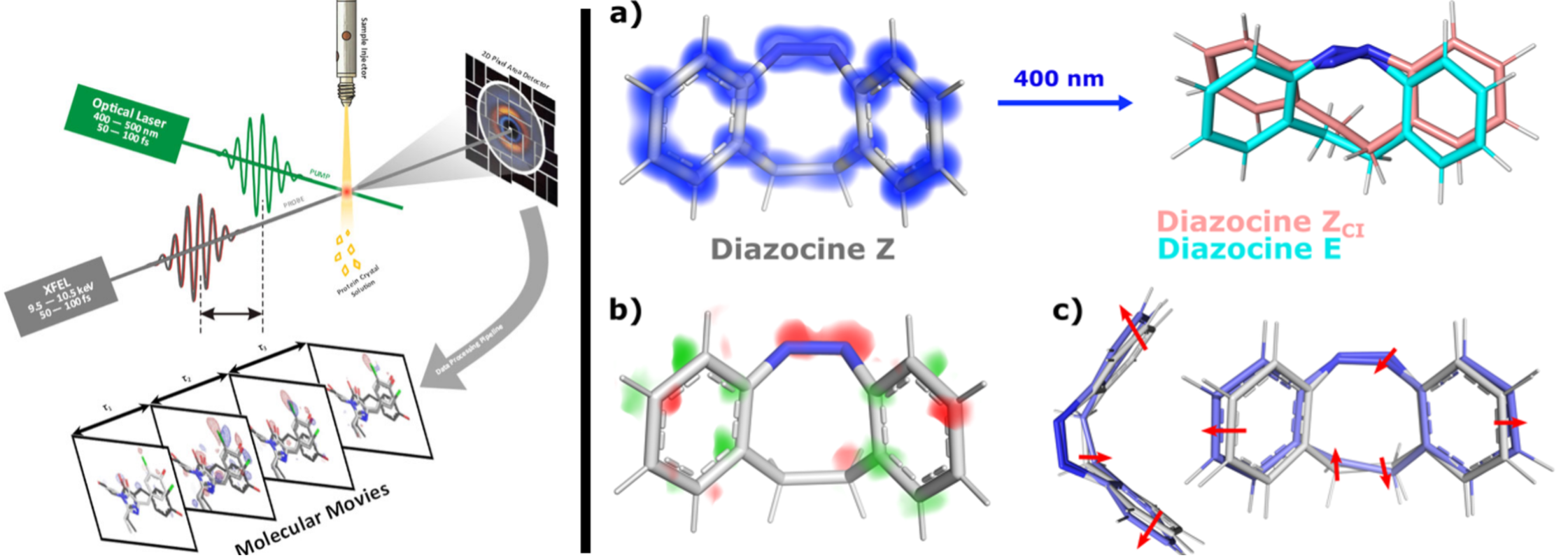
Fig 1. Left: Pump–probe TR-SFX schematic. An optical pulse excites microcrystals, and femtosecond X-ray pulses probe the structure at defined time delays. Right: Structural dynamics of a sterically constrained bridged azobenzene. a) Ground-state Z-diazocine electron density at 0.88 Å resolution, with TD-DFT E and ZCI structures.[3] b) Difference electron density at 300 fs (±3σ). c) Extrapolated 300 fs structure, revealing early N=N bond twisting, distortion of the ethyl bridge, and increased planarity of the aromatic ring.
[1] G. Khusainov, J. Standfuss, T. Weinert, Structural Dynamics, 2024, 11, 020901.
[2] J. Kang, et al., Nature Chemistry, 2024, 16, 693–699.
[3] R. Siewertsen, et al., Physical Chemistry Chemical Physics, 2011, 13, 1054–1063.