Synthesis, Isolation, and Reactivity of Gold(III) Phosphaketene Complexes
The phosphaethynolate anion (PCO−) was first introduced by Becker in 1992, and its ambidentate nature was subsequently demonstrated in different studies featuring salt metathesis reactions between NaPCO and different metal halides. As expected, coordination through the phosphorus atom was found to be favored by soft and polarizable elements, while hard and charge-dense Lewis acids preferred the oxygen-bound coordination[1-3]. The reductive decarbonylation of metal-phosphaketene (M−PCO) complexes was found to be a key synthetic strategy to access terminal M−P complexes,[4-6] which constitute promising platforms for phosphorus atom transfer (PAT) catalysis.
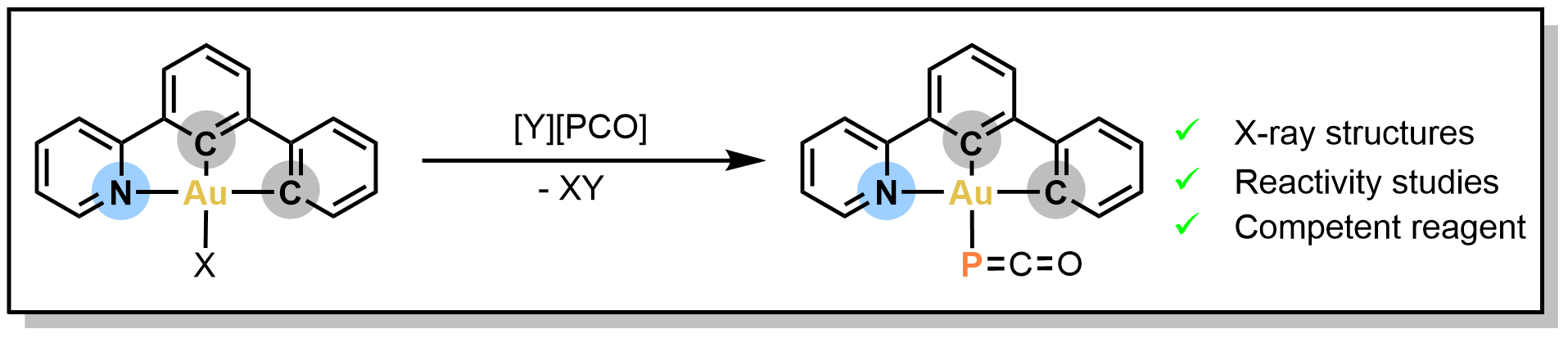
Herein, we report the characterization and reactivity of the first family of well-defined Au(III)-phosphaketene complexes supported by different tridentate (N^C^C) and (C^N^C) ligands. Our investigations revealed that the behavior of the Au(III)-PCO complexes is strongly governed by the ligand framework, which can either facilitate decarbonylation or promote PCO transfer, depending on its electronic and steric properties.
[1] J. Goicoechea, H. Grützmacher, Angew. Chem. Int. Ed., 2018, 57, 16968 – 16994.
[2] J. Sun, H. Verplancke, J. I. Schweizer, M. Diefenbach, C. Würtele, M. Otte, I. Tkach, C. Herwig, C. Limberg, S. Demeshko, M. C. Holthausen, S. Schneider, Chem, 2021, 7, 1952–1962.
[3] L. Liu, D. A. Ruiz, D. Munz, G. Bertrand, Chem, 2016, 1, 147-153.
[4] L. L. Liu, D. A. Ruiz, F. Dahcheh, G. Bertrand, R. Suter, A. M. Tondreau, H. Grützmacher, Chem. Sci., 2016, 7, 2335–2341.
[5] R. R. Thompson, M. T. Figgins, D. C. Wannipurage, A. Renteria-Gomez, A. R. Gogoi, J. Telser, D. L. Tierney, M. C. Neben, S. Demeshko, O. Gutierrez, D. C. Powers, J. Am. Chem. Soc., 2025, 147, 5350−5359.
[6] M. C. Neben, N. Wegerich, T. A. Al Said, R. R. Thompson, S. Demeshko, K. Dollberg, I. Tkach, G. P. Van Trieste, H. Verplancke, C. von Hänisch, M. C. Holthausen, D. C. Powers, A. Schnegg, S. Schneider, J. Am. Chem. Soc., 2025, 147, 5330−5339.