Cp*M Complexes with the N-Heterocyclic Vinylidene Ligand IPrC
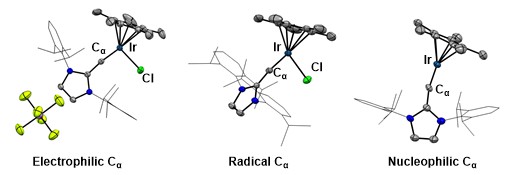
Room-temperature stable diazoolefins provide access to a unique class of carbon-donor ligands: N-heterocyclic vinylidenes. [1] Herein, we describe Cp*M complexes with the N-heterocyclic vinylidene ligand IPrC (IPr = 1,3-bis(2,6-diisopropylphenyl)-imidazol-2-ylidene). Cationic complexes of type [Cp*IrCl(IPrC)]X (X = SbF6, OTf) were obtained by reaction of (Cp*IrCl2)2 with IPrCN2, followed by chloride abstraction. Two-electron reduction instead of chloride abstraction gave a neutral Cp*Ir(IPrC) complex with a “pogo stick” geometry.[2] Single-electron reduction of the cationic complexes afforded Cp*IrCl(IPrC), in which the vinylidene ligand shows radical character. Combining (Cp*RuCl2)2 with IPrCN2 gave Cp*RuCl2(IPrC), in which the vinylidene ligand also shows radical character. Hydrogen abstraction from Et3SiH yielded the carbene complex Cp*RuCl2(IPrCH). The diamagnetic complex Cp*RuCl(IPrC) was obtained by single-electron reduction of Cp*RuCl2(IPrC), whereas single-electron oxidation with [TEMPO]X provided ionic [Cp*RuCl2(IPrC)]X (X = BF4, SbF6) complexes. Reactions of (Cp*OsBr2)2 with IPrCN2 resulted in disproportionation and formed Cp*OsBr(IPrC) and [Cp*OsBr2(IPrC)]Br, while single electron reduction of [Cp*OsBr2(IPrC)]Br formed the meta-stable Cp*OsBr2(IPrC) and the vinylidene ligand also shows radical character.[3] The results underline the unique electronic properties of the vinylidene ligand IPrC in transition metal complexes.
[1] B. Kooij, T. H. Wong, K. Severin. Chemia., 2025, 79, 855-858
[2] T. H. Wong, P. Varava, F. Faraei-Tirani, R. Scopelliti, K. Severin. J. Am. Chem. Soc., 2025, 147, 19911-19917.
[3] T. H. Wong, A. Sienkiewicz, F. Faraei-Tirani, R. Scopelliti, K. Severin. Manuscript in preparation.