Breaking Kasha’s Rule in Gold Nanoclusters: Unconventional Photophysics of [Au₂₅(PET)₁₈]⁰
Atomically precise gold nanoclusters (NCs) are promising materials for photocatalysis, biosensing, and solar energy conversion, yet their fundamental excited-state dynamics remain poorly understood due to experimental limitations and incomplete spectral characterization.[1] Among the more than 100 structurally resolved metal NCs with ultra-small cores (<2 nm), Au25(SR)18 (SR = PET, 2-phenylethanethiol) is the most extensively studied and typically exists in three oxidation states (−1, 0, +1). However, systematic photophysical investigations remain scarce because of limited NIR sensitivity in commercial fluorometers and the lack of accurate measurements.[2] Here, we present a combined steady-state and time-resolved spectroscopic study of neutral Au25 NCs using a custom-built setup with extended near-infrared sensitivity, emphasizing the importance of instrumentation design for reliable characterization.
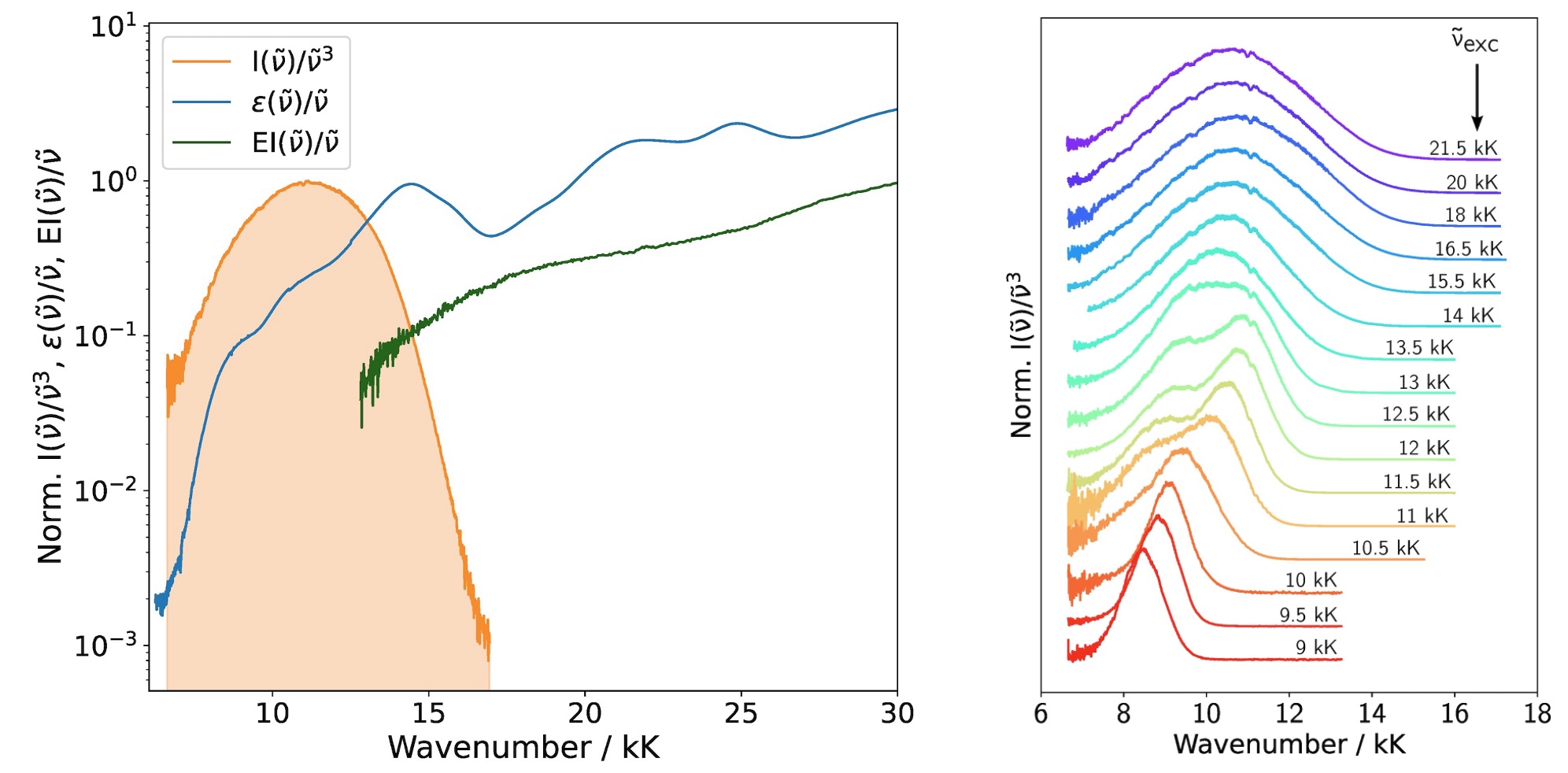
Our results reveal a low-energy absorption band at ~9 kK (fig. 1), not previously reported, together with a pronounced excitation-energy dependence of both the emission profile and peak position (fig. 2), representing the first observation of such behavior in gold nanoclusters. Time-resolved measurements further show distinct temporal evolution for each excitation energy and highly distributed, strongly non-monoexponential photoluminescence decays over the ns–μs timescale. Compared with the closed-shell anion, the neutral cluster displays clear deviations from Kasha’s and Vavilov’s rules. These observations support a working hypothesis involving dark states and delayed fluorescence to explain the unconventional emission pathways and relaxation dynamics of the neutral species. To gain deeper insight into these effects, comparative studies were performed on Au25⁻, Au38⁰, and Au132+ nanoclusters, all of which are of interest due to the presence of Au13 icosahedral motifs in their cores. Complementary low-temperature and quenching experiments were also conducted to further clarify the nature of the excited states. Together, these results provide a basis for proposing a Jablonski diagram and a kinetic model to rationalize the observed relaxation dynamics.
[1] I. Chakraborty, T. Pradeep, Chemical Reviews, 2017, 117, 8208–8271
[2] L. E. Llanes-Montesino, G. Angulo, J. Zhao, T. Bürgi, A. Rosspeintner, Chimia, 2026, 80, 1–4