A Photochemical Nitrate-to-NO Assay Enabled by Light-Driven Oxygen Vacancy Formation in Polyoxovanadates
Photochemical assays that couple small-molecule reactivity to direct optical readout are attractive for the chemical sensing of challenging analytes.[1] Reactive oxygen vacancies (OVs) in metal oxides are attractive motifs for such systems because of their rich small-molecule activation chemistry,[2] yet their formation and reactivity are often difficult to study directly in structurally heterogeneous materials. Polyoxovanadates (POVs) provide molecularly well-defined, soluble metal-oxide platforms for solution-state spectroscopic study of oxygen-vacancy chemistry.[3]
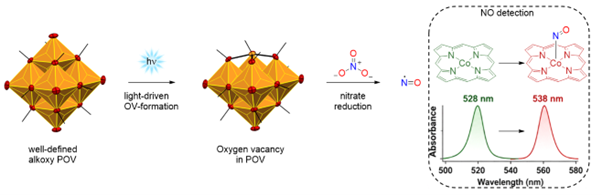
Herein we report a photochemical nitrate-to-NO assay based on light-driven OV generation in the POV V6O7(OMe)12 (V6O7). Upon irradiation, vacancy-bearing clusters are formed in situ and subsequently reduce nitrate to NO, which is monitored in real time via a cobalt porphyrin signaling array. Solution-state spectroscopy identified key intermediates, while NO capture was tracked through a diagnostic Q-band shift in the cobalt porphyrin (528 → 538 nm upon nitrosyl-complex formation[4]). Addition of varying equivalents of TBANO3 produced proportional Q-band shifts consistent with quantitative NO formation. The assay operates in the low-ppm nitrate regime and provides a direct optical readout of photochemical nitrate reduction. These results demonstrate light-driven OV formation in polyoxovanadates and establish them as molecular metal-oxide platforms for coupled photochemical reactivity and optical reporting.
[1] B. J. Bezner, S. L. Ryan, A. R. Lippert, Analytical Chemistry, 2020, 92, 1, 309–326.
[2] Z. Yu, D. Yu, X. Wang, M. Huang, W. Lin, M. Anpo, J. C. Yu, J. Zhang, X. Wang, Journal of the American Chemical Society, 2025, 147, 16, 13885–13892.
[3] S. Chakraborty, B. E. Petel, E. Schreiber, M. E. Matson, E. M., Nanoscale Advances, 2021, 3, 1293-1318.
[4] G. B. Richter-Addo, S. J. Hodge, G.-B. Yi, M. A. Khan, T. Ma, E. Van Caemelbecke, N. Guo, K. M. Kadish, Inorganic Chemistry, 1996, 35, 22, 6 530–6538.