Competition between photoionization and predissociation in electronically excited states of He2 studied by simultaneous detection of metastable He fragments and He2+ ions.
He2 has been called a "Rydberg molecule" because its ground electronic state is repulsive, whereas its electronically excited states are strongly bound and have Rydberg character [1,2]. In previous studies, only low vibrational levels (v ≤ 3) of these electronic states have been studied, and almost no information is available on vibrational levels with v ≥ 4.
We have recently demonstrated that 1+1' two-photon excitation via the v = 3 and 4 levels of the c 3Σg+ state provides access to very high vibrational levels of high-lying Rydberg states of He2 [3]. In the present work, we introduce an experimental approach to systematically study the high vibrational levels of electronically excited states of He2 using 1+1' excitation via the c 3Σg+ state. This approach relies on the simultaneous detection of photoionization and predissociation processes.
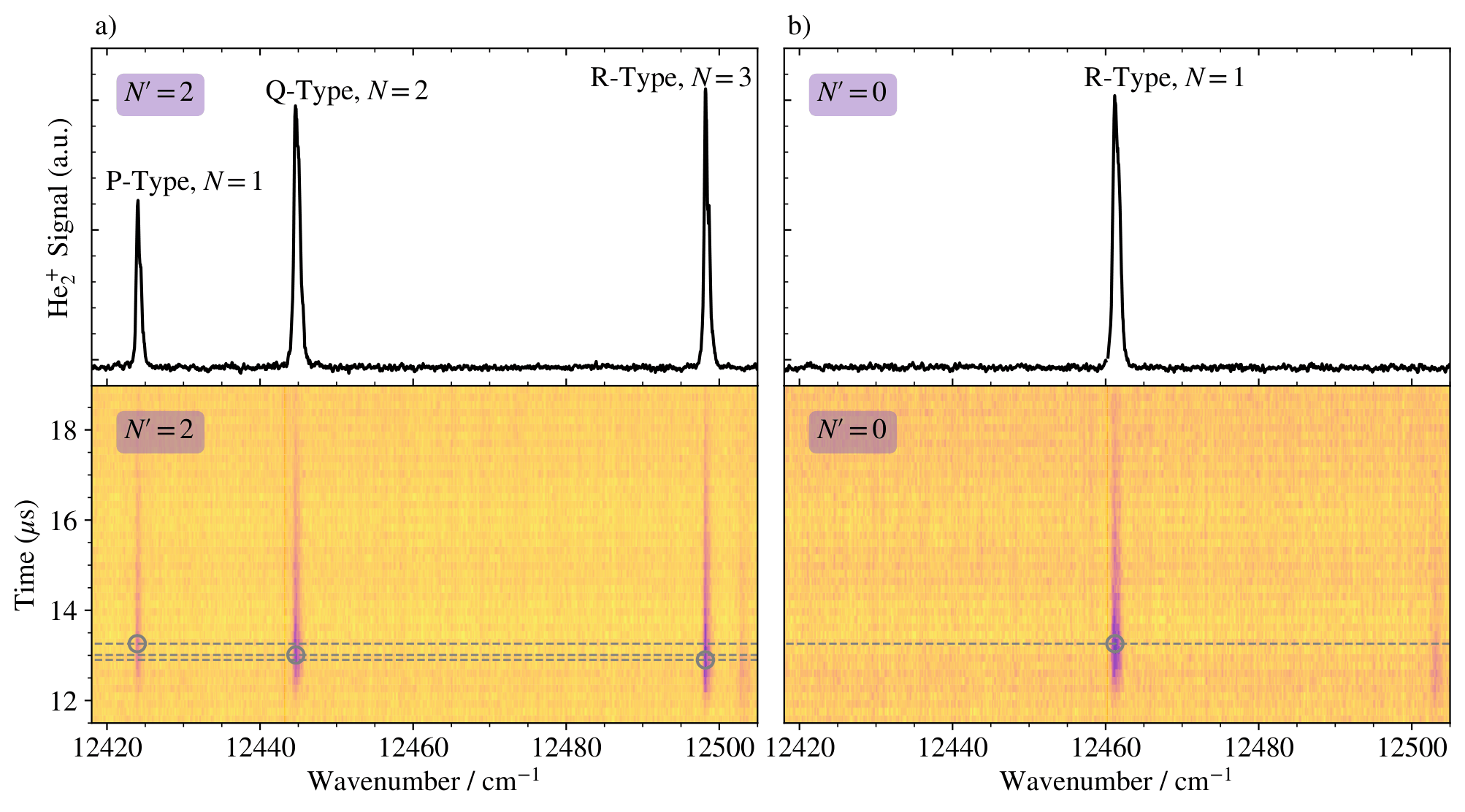
The well-characterized c 3Σg+(v = 4) [3-5] state was used to calibrate the experiment and demonstrate the very efficient detection of tunnelling predissociation in He2 by monitoring the metastable He(1s2s) 3S1 fragments on a microchannel-plate (MCP) detector. This detection method was then applied to study transitions to vibrationally excited levels of the f 3Σu+, f ' 3Πu, and d 3Σu+ states. This contribution presents the main results of this study. As an example, the figure displays the spectra of the f ' 3Πu(v = 3, N = 1, 2, 3) ← c 3Σg+(v = 2, N = 0, 2) ← a 3Σu+(v = 0, N = 1) transitions. In both panels, the upper spectrum corresponds to the He2+ signal produced by photoionization, and the lower spectrum corresponds to metastable He* atoms produced by predissociation of the f' state. The maxima in the time-of-flight distributions are marked by open cicrles, and dashed gray lines indicate the corresponding flight timesThe ability to detect dissociation products makes it possible to observe transitions to rapidly dissociating molecular states that cannot be observed by photoionization or laser-induced fluorescence.
[1] G. Herzberg, Ann. Rev. Phys. Chem., 1987, 38, 27.
[2] M. L. Ginter, and J. G. Eden, Can. J. Chem., 2004, 82, 6.
[3] M. Holdener, V. Wirth, N. A. Shahin, M. Beyer, and F. Merkt, Phys. Rev. A, 2025, 112, 2.
[4] V. Wirth, M. Holdener, and F. Merkt, Phys. Rev. A, 2025, 112, 3
[5] I. Hazel, A. Norregaard, and N. Bjerre, J. Mol. Spectrosc., 1995, 172, 1