Tri-coordinated Ga Alkoxide: Surface Model of Lewis Acidic Ga Sites
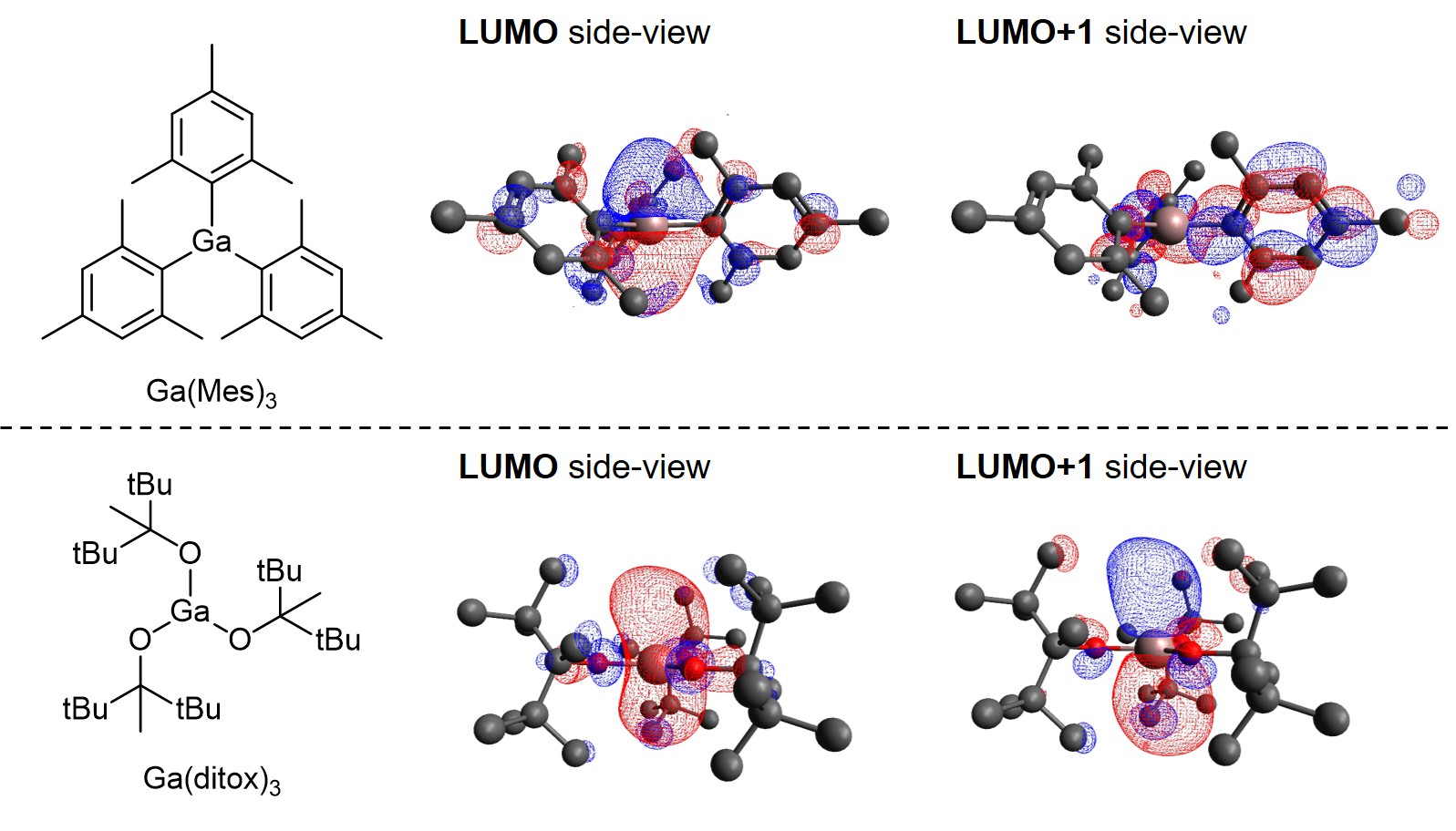
Gallium-containing metal oxides have been explored as industrially relevant catalysts for COx-hydrogenation and alkane dehydrogenation processes, with the help of its unique feature, such as Lewis acidity, redox properties and/or formation of metal alloys.1,2 In particular, Lewis acidic features at the surface Ga sites are strongly dependent on the coordination environment and the geometry. However, the identification of the respective Ga surface sites remains challenging due to the presence of various Ga species on metal oxides. The investigation into the spectroscopic signatures, i.e. X-ray absorption spectroscopy (XAS) and solid-state NMR, of Ga model-complexes can be one of the powerful approaches to capture Ga surface sites by comparing Ga-containing materials.3-6 While various Ga complexes have been reported as the surface models of Ga sites, such as tri-coordinated Ga complexes surrounded by N or C atoms7,8 and tetra-coordinated Ga complexes surrounded by O, N or C atoms,4-6 the synthesis of tri-coordinated Ga complexes surrounded by only O atoms has not been achieved even though such Ga complexes would be ideal models for surface Lewis acidic Ga sites on metal oxides. Herein, we synthesize a Ga tri-alkoxide complex as a monomer determined by single crystal X-ray diffraction, whose XAS feature is compared with the other tri-coordinated Ga complexes, i.e. Ga tri-aryl and Ga tri-amide, in order to explore the spectroscopic signature from different chemical environments in the same conformation. The visualized molecular orbitals using DFT calculation reveals the observed differences in XAS are derived from the contribution of pz orbital from Ga in each tri-coordinated Ga complex at LUMO or LUMO+1.
[1] Docherty, S. R.; Rochlitz, L.; Payard, P.-A.; Copéret, C. Chem. Soc. Rev. 2021, 50 (9), 5806-5822. [2] Zhou, W.; Hansen, C.; Cao, W.; Brack, E.; Docherty, S. R.; Ehinger, C.; Wang, Y.; Wang, C.; Copéret, C. JACS Au 2025, 5 (1), 217-224. [3] Getsoian, A. B.; Das, U.; Camacho-Bunquin, J.; Zhang, G.; Gallagher, J. R.; Hu, B.; Cheah, S.; Schaidle, J. A.; Ruddy, D. A.; Hensley, J. E.; et al. Catalysis Science & Technology 2016, 6 (16), 6339-6353. [4] Rochlitz, L.; Searles, K.; Nater, D. F.; Docherty, S. R.; Gioffrè, D.; Copéret, C. Helv. Chim. Acta 2021, 104 (7), e2100078. [5] Docherty, S. R.; Völker, L. A.; Yakimov, A. V.; Verel, R.; Copéret, C. J. Phys. Chem. C 2023, 127 (51), 24552-24563. [6] Liu, K.; Riu, M.-L. Y.; Shan, J.-R.; Zarnitsa, L. M.; Houk, K. N.; Nava, M. J. Am. Chem. Soc. 2025, 147 (46), 42441-42451. [7] Beachley, O. T., Jr.; Churchill, M. R.; Pazik, J. C.; Ziller, J. W. Organometallics 1986, 5 (9), 1814-1817. [8] Brothers, P. J.; Wehmschulte, R. J.; Olmstead, M. M.; Ruhlandt-Senge, K.; Parkin, S. R.; Power, P. P. Organometallics 1994, 13 (7), 2792-2799.