Nitrile Activation in Platinum-Based Ligand Backbone Manipulation
Skeletal editing has emerged as a promising tool to access valuable derivatives by direct modification of the molecular scaffold.1 In recent years several strategies for the insertion and deletion of carbon or nitrogen atoms have been developed.2 Such single atom manipulations have been by far the most prominent3,4, while the insertion of two or more atoms into an existing backbone is essentially unknown.
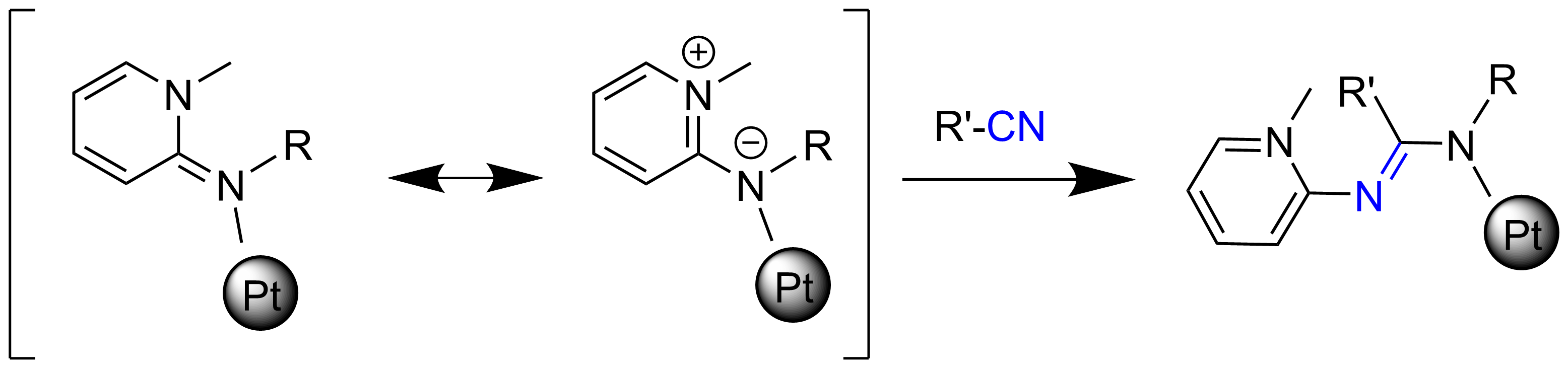
Here we will demonstrate the metal-mediated insertion of a -CN- fragment from small molecule nitriles into the backbone of the ligand, thus expanding the toolbox of skeletal editing methodologies. The reaction involves C–N bond breaking and both N–C and C–N bond making processes in one step. Key for this unprecedented bond activation and insertion reaction is a platinum(II) center bound to pyridinium amidate (PYA) ligands (see Figure below). These ligands are known for their electronic flexibility, which entails neutral and zwitterionic limiting resonance structures. Previous work has demonstrated a wide range of catalytic applications with these PYA ligands, including redox and polymerization processes.5,6
Here we will discuss the -CN- insertion in more detail, including selectivity and mechanistic aspects, as well as scope for diversification.
[1] Yuqi Chen, Guanzheng Feng, Yisan Shen, Zhihao Liu, Chenghui Sun, Weixiao Ji, He Huang, Siping Pang J. Am. Chem. Soc. 2026, 148, 3, 3672–3680
[2] Sojung F. Kim, Charis Amber, G. Logan Bartholomew, Richmond Sarpong Acc. Chem. Res. 2025, 58, 11, 1786–1800
[3] Julia C. Reisenbauer, Ori Allegra Franchino, Patrick Finkelstein, Bill Morandi Science 2022, 377, 1104– 1109
[4] Sean H. Kennedy, Balu D. Dherange, Kathleen J. Berger, Mark D. Levin Nature 2021, 593, 223–227
[5] James J. Race; Martin Albrecht ACS Catal. 2023, 13, 14, 9891–9904
[6] Esaïe Reusser. ; Martin Albrecht Catal. Sci. Technol. 2025, 15, 7464-7472