Resistance to Overdoping Allows Over 2000 S cm−1 Conductivity in P(g3BTTT) With Anion-Exchange Doping
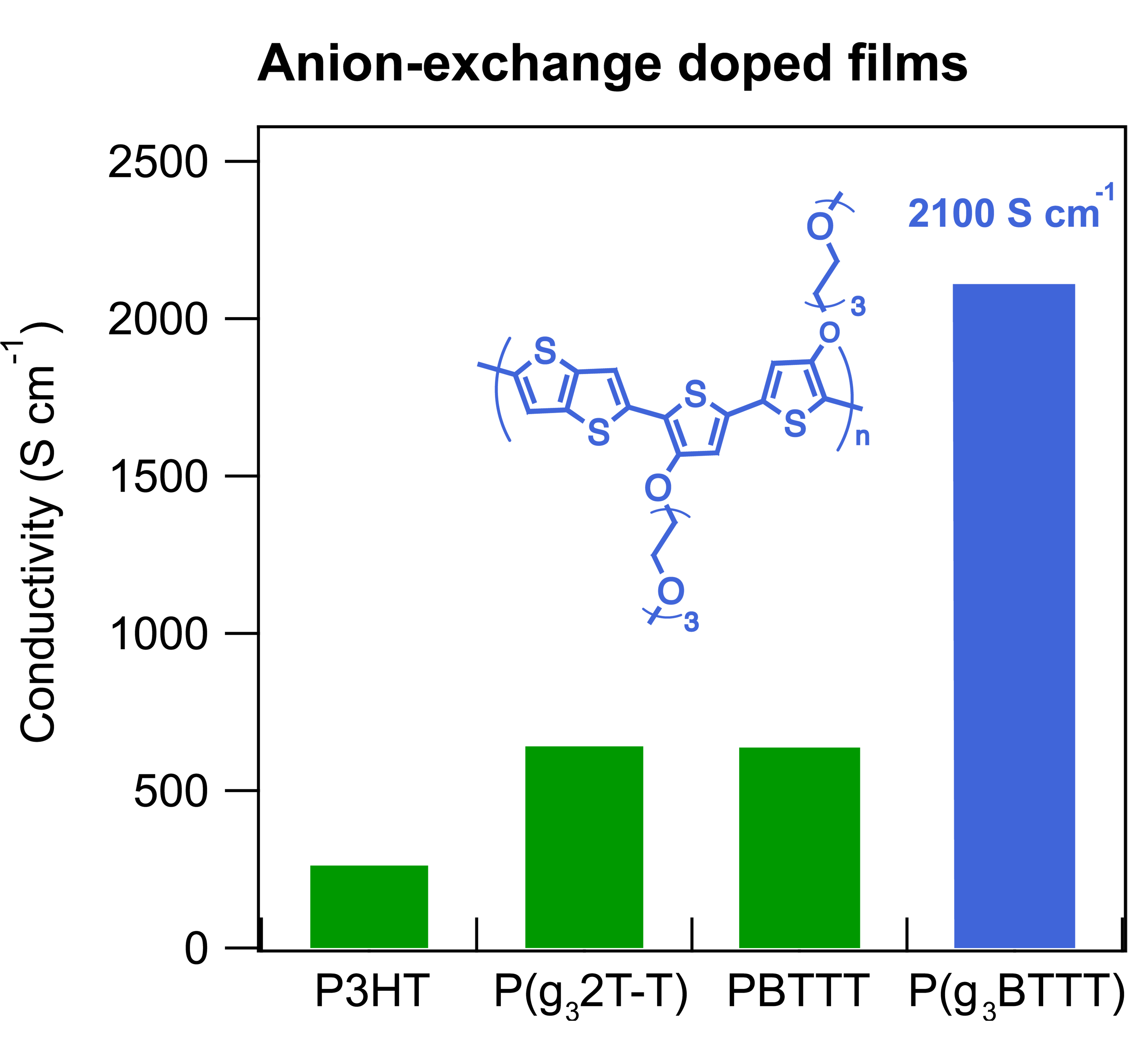
Organic semiconductors have a wide range of near future applications, such as bioelectronics, thermoelectronics and optoelectronics1,2 where their low production cost and chemical tunability make them very attractive candidates for the aforementioned fields. Current challenges include the low conductivity which can be addressed via doping. In particular for conjugated polymers doping increases the conductivity by several orders of magnitude2-4. Recently, sidechain engineering has been shown to be a useful tool for the modification and improvement of conjugated polymers5. By exchanging the commonly used alkyl sidechains with glycol sidechains the dopant-polymer miscibility and the ionic uptake is improved6. Herein we investigate how these improvements affect chemical and anion exchange doping of thiophene and thienothiophene type polymers in respect to their conductivity. To characterize these changes, we use steady state absorbance spectroscopy, four-point probe, time domain THz spectroscopy, in situ absorbance measurements and chronoamperometry. For P(g3BTTT), we find extraordinarily high conductivities of over 2 000 S/cm combined with a high charge carrier mobility. We show that transport involves delocalized charges, that all generated charges participate to the transport, and that the mobility is resilient over nanometer to micrometer length scales. However, the high-doping regime also shows a trade-off between high charge density and high mobility, limiting the conductivity at excess concentrations of doubly charged species. Surprisingly, P(g3BTTT) is resistant to this ‘overdoping’ effect and sustains particularly high levels of doubly charged species without drop in mobility. The exceptional conductivity of doped P(g3BTTT) can thus be related to the high doping level that is achieved thanks to the oligoether side chains, without significant trade-off on the concomitantly high mobility.
[1] W. Zhao et al. “Chemical doping of organic semiconductors for thermoelectric applications”. In: Chemical Society Reviews 49.20 (Oct. 19, 2020), pp. 7210–7228.
[2] B. Lüssem, M. Riede, and K. Leo. “Doping of organic semiconductors”. In: phys- ica status solidi (a) 210.1 (2013), pp. 9–43.
[3] Aasmundtveit, K. E. et al. Structural aspects of electrochemical doping and dedoping of poly(3,4-ethylenedioxythiophene). Synth. Met. 113, 93–97 (2000).
[4] Murrey, T. L. et al. Anion Exchange Doping: Tuning Equilibrium to Increase Doping Efficiency in Semiconducting Polymers. J. Phys. Chem. Lett. 12, 1284–1289 (2021).
[5] Giovannitti, A. et al. Controlling the mode of operation of organic transistors through side-chain engineering. Proc. Natl. Acad. Sci. U. S. A. 113, 12017–12022 (2016).
[6] Peterson, K. A., Thomas, E. M. & Chabinyc, M. L. Thermoelectric Properties of Semiconducting Polymers. Annu. Rev. Mater. Res. 50, 551–574 (2020).